Sunday, October 20, 2013

Teethmarks - Let's get drunk and break shit

      One of the best things about studying in Canada is that I get exposed to a lot of bands that, due to monetary constraints, are only able to tour in the great white north. Now, obviously the opposite would be true if I lived in the States, but I'd be lying if I said my knowledge of Cannuck metal has swollen insanely since I moved to Montreal.
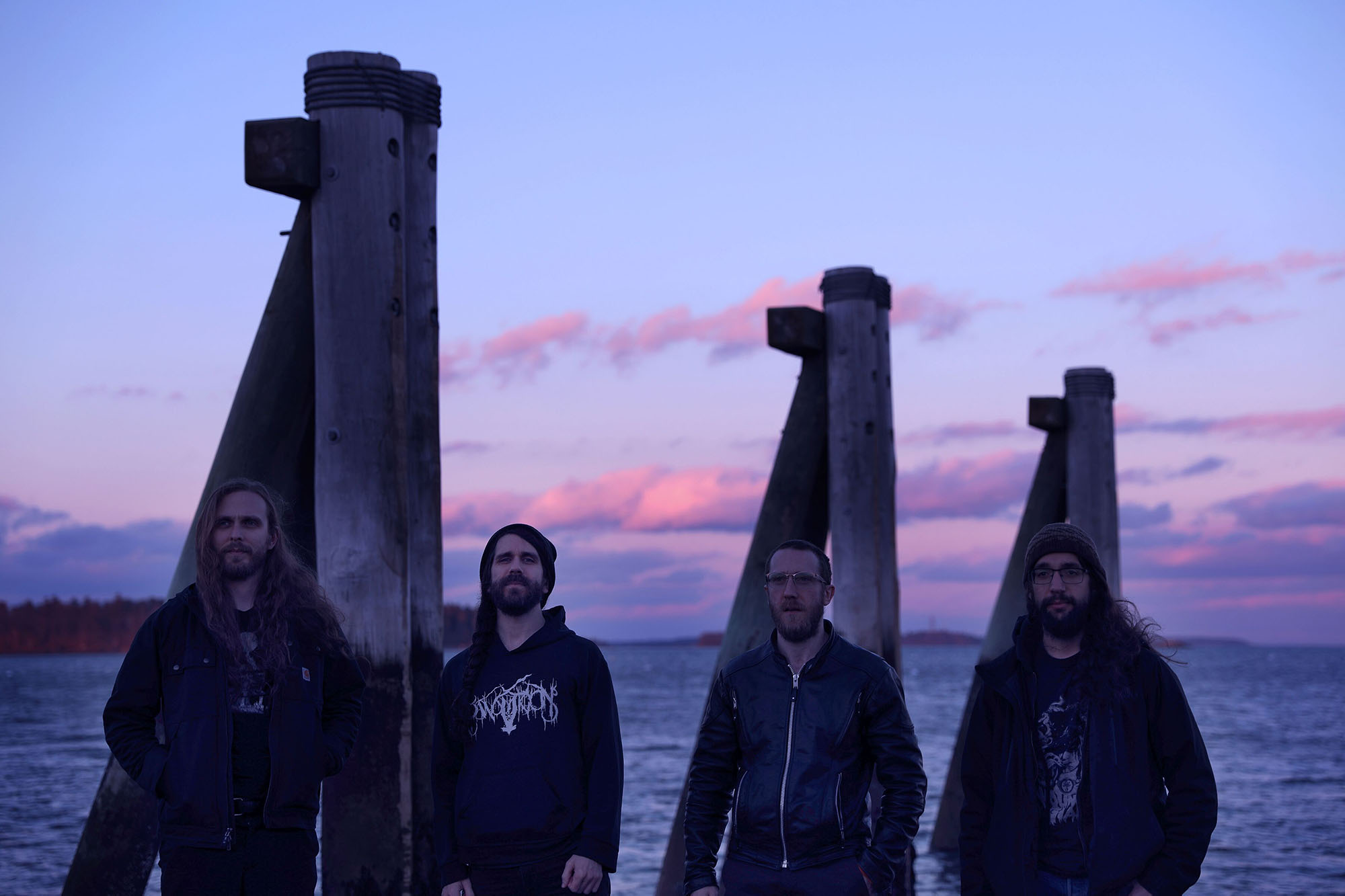
      And that's great, because there's a lot of amazing stuff to be found here - Hoopsnake from British Columbia, Dead Ranch from Manitoba, and Quebec's own breathtaking DSBM overlord Sombres Forêts. But last night I went to see a concert hosted by  Pelecanus, a DIY metal magazine from Montreal, and found myself confronted (in the purest sense of the word) by crossover band Teethmarks.


     The only moshpit of the show was during this band's set, and as their vocalist leapt from the stage to pace about furiously among the dirty bastards in the crowd, my roommate and I were totally transfixed. This is some of the filthiest, drunkest music you'll ever hear - a soundtrack to nights filled with bad ideas and booze. Comparisons to Cancer Bats (who hail from the same city as Teethmarks, Toronto) are inevitable for me, but there is a clear winner in this regard. 
     Something about that perfect mix of southern rock and thrash...
     If you need more proof, then for me, Teethmarks stole the show from the almighty Dopethrone. Now ain't that something.

Sunday, October 13, 2013

Celeste (France) announce new album, debut art and track list

The raw, filthy misanthropy that is France's Celeste have announced their fourth studio album, Animale(s). A pulse-pounding mixture of black metal and hardcore, the band fell silent after 2010's Morte(s) Nee(s), and have recently broken the silence with a flood of new information. Animale(s) is slated for release on November 22nd through Denovali Records, who some of you may know as the label for German masterminds Omega Massif, and is slated to be a double-disc release.

The album art is, as usual, a black-and-white photograph, and this time hearkens back to the Morte(s) Nee(s) cover:

 And the tracklisting is as ornate as ever (horrible translation in parentheses)


(Disc 1)

1. Laissé pour compte comme un bâtard 5:01 (Cast off like a bastard)

2. Au pied d'une bicoque peu séuisante 3:12 (On foot from a hardly seductive shack)

3. Sans crainte de s'avouer un jour naufragée 3:32 (Without fear of confessing a wasted day)

4. (X) 6:36

5. Tes âmes soeurs immaculées 5:20 (Your immaculate soul sisters)

6. Dans ta salive, sur sa peau 9:20 (In your saliva, on your skin)

(Disc 2)

1. D'errances en inimitiés 7:25 (Errors in hostility)

2. Cette silhouète paumée et delabrée qui sanglote et meurt 7:30 (This damned silhouette and wreck that sobs and dies)

3. Emprunte d'érotisme 2:31 (The Borrowing of Erotism)

4. (Y) 3:20

5. Serrés comme son coeur lacéré 7:17 (As locked as his lacerated heart)

6. Outro 8:09


UPDATE 10/18 - The band has premiered the first song of the album, 'Laissé pour compte...' on Soundcloud along with a discussion of the album's vision and concept.

The concept behind ANIMALE(S) is the bleak story of a boy and a girl, a kind of love story with a tragic ending. A story about how tough youth can be if parents discard their responsibilities. For once in metal-oriented music, a closer look at artwork and lyrics gives a new dimension to a record and is indispensable for a comprehensive and complete experience of this double album.
While I think the whole 'for once in metal' thing is a bit of a stretch, this does promise to be quite an interesting record. You can stream the song at the link below:

Friday, October 11, 2013

DSBM and Post-Black Metal - More similar than you'd think

    DSBM (Depressive Suicidal Black Metal) presents one of the strangest cases in modern black metal - stylistically, it's as much of a departure from the grim, frostbitten style of Mayhem as it is bizarre that the style is accepted by black metal fans the world over. It's an intriguing phenomenon that belies a strange inconsistency in the BM community - while bands like Alcest or Lantlôs are ridiculed and ostracized for not being 'true' enough for the scene, DSBM has been a valued (and intensely scrutinized) part of the scene for many years now. While, of course, Alcest and Xasthur are utterly different bands, the problem arises when you consider that there isn't much of a difference between post-black metal and DSBM. The two genres share a variety of stylistic elements - ambient keyboards, and an emphasis on emotion over the fierce anti-Christian zeal of so-called 'kvlt' BM, to name a few.
      So, then, what gives Silencer a free pass? Well, it might have to do with the fact that one of the first artists to use what would come to be called the 'DSBM' sound was none other than everyone's favorite crazy one-man act, Burzum.
       Hvis Lyset Tar Oss, especially the track 'Det Som Engang Var', is a prime example of what is commonly cited as black metal's 'cold' sound. While there is, as usual, the anthemic feel that Varg imbues most of his work with, his pained screams and the haunting synthwork mold together into a profoundly heavy product. But this song isn't heavy in the way you'd expect - 'Hvis Lyset Tar Oss' (the song) is emotionally heavy. It grasps at your soul and drags it down. Everything from the cold white light and dead trees of the cover, to the titles of the songs (Translated as 'Emptiness', 'That Which Once Was', etc.) paint a dreary portrait which BM artists had eschewed in favor of satanic imagery.
       Fenriz (Darkthrone) credits Burzum with introducing an 'inexplicable grimness' to the scene that would never quite leave. Much to the contrary, an entire subgenre emerged around it, but it wasn't until the early 2000s that DSBM began to emerge into its own.
       As with death metal before it, DSBM has its own mainstays in both Europe and North America - Sweden's Silencer and California's Xasthur followed in Vikernes' footsteps in painting stark, lonely music reminiscent of soul-crushingly dark winter nights.
(N.B I love the record 'To Violate the Oblivious' waaaaay more than I ought to)
      'Walker of Dissonant Worlds' is a prime example of the influence Burzum wrought on Xasthur (Malefic has gone on record saying the fact that Burzum was a one-man act inspired him to do the same with Xasthur). Again, we get those haunting keyboards that fade out ever so slowly. The end-result is profoundly depressing music.
      Meanwhile, Silencer's fifteen minutes of fame (in the form of Death, Pierce Me) were a bit more ad hoc. Sure, you have your dissonant synths, but you do have more traditional black metal passages scattered throughout - such as here - even if the end result (and the subject matter) is insanely soul-crushing.
      That being said, Silencer remained far more entrenched in true black metal to effect much change. Death, Pierce Me is, by and large, a mostly unmelodic album, a stylistic choice that comes to mind for me when I think about DSBM as a genre. I think I'm one of the few people who thinks DSBM didn't really get started in Europe until the mid-2000s, when Make a Change...Kill Yourself emerged from Denmark.
       In my opinion, at least, Make A Change... expounded on the Burzum model from the early 90s in that you have that fusion of mournful synthwork overlaid with rapidly strummed black metal guitar, which has come to become a trademark of DSBM as a genre entirely. If you consider some contemporary DSBM - Moloch, for example - you commonly find the two juxtaposed. Thus, while Silencer definitely put some of the gears into place for DSBM to emerge in Europe, the development of the genre formally began with Make A Change...Kill Yourself.
       But now that I've talked a bit about the history of DSBM as a whole, the question remains - why is it okay while post-black isn't? Well, the answer seems to lie primarily in chronology. As I mentioned in my post about Watain's new album, black metal fans take the xenophobia of metalheads to new lengths - the stereotypical trve kvlt fan shuns and despises any sort of music that takes influence from, but isn't exactly, black metal.
        However, there is a corollary to that rule - DSBM gets a free pass because, (a) it came first, and (b) it doesn't usually involve elements of so-called 'hipster' genres, which post-black takes plenty of cues from. You won't find post-rock passages and airy, dissonant shoegaze in any of Leviathan's music. Pretty much the only major musical different between lo-fi 'raw' black metal and DSBM is in DSBM's heavier reliance on creating a sadder, more emotional atmosphere through the use of synths. 'Blackgaze' or post-black metal is oftentimes a departure from the style set down by Celtic Frost and Darkthrone, and for that reason, it earns the ire of black metal fans for not embodying the spirit of the genre it descends from.
         Whatever the case, the arbitrariness of DSBM's being 'acceptable' seems altogether too simple. Just because it's a subgenre that emerged in the early 2000s shouldn't preclude it from criticism, considering lots of bands pretend they live in Oslo in 1993. What do you think? Is there another reason metal fans are less likely to hate on DSBM?

Tuesday, October 1, 2013

Avenged Sevenfold - Hail to the King REVIEW

   
Way back in the prehistoric ages of the 2000s, I was obsessed with Avenged Sevenfold. I was bummed when their drummer "the Rev" died in 2009, and I waited on tenterhooks as Nightmare came and...utterly disappointed.
      I'm sorry, but the band's 2010 release is a dismally boring album. Especially considering this is the act that brought us behemoths like Waking the Fallen and City of Evil. Nightmare came off as disjointed - a wince-worthy collection of ideas that were too stupid to be on their self-titled album, but in the context of a dedication album seemed to fit - and the exhausting ten-minute memorial track 'Save Me' was, as far as I could tell, a nail in the coffin. What happened next seemed to confirm my suspicions. The band proceeded to fall off the radar musically - sure, they released a few singles to promote new Call of Duty games, but as far as I saw, the band didn't stop whining about the death of "the Rev".
       Mike Portnoy played with Sevenfold (remember that?), but they turned him down because it 'just wasn't the same'. Finally, three years later, Hail to the King has hit shelves. And, so far, it's quite the album. The intro 'Shepherd of Fire' seems straightforward enough - as the band moves from an eerie bell chime into the familiar Guns N' Roses-tinted guitar attack and pounding drumwork we've grown accustomed to. As the song bursts into being, the Sevenfold we know and love - melodic hooks and cock-rock accoutrements - hits the ground running..
         Topically, Hail to the Kking plays like the better parts of their more radio-friendly self-titled release ('Afterlife, 'Brompton Cocktail'), while never veering too strongly into the whiny negativity of Nightmare. Sure, the style they put forward on Nightmare has evolved and changed, but everything from the lyrical quality to the guitar solos leaves no sign of travesties like 'Danger Line' or 'Victim'. Guitarist "Synyster Gates"' throbbing fetish for sweep picking is also back - and for the most part the guitarwork in this album is full of 80s obtuseness - that is to say, flat out fun. If Avenged Sevenfold have done one thing right since they abandoned metalcore in 2005, it's the flat out fun you have while listening to them, and the infectious quality of their work. Listening to this album now, I can tell 'Doing Time' is going to be stuck in my head for quite a while.
         My one qualm with the production is that the drums are much too loud, and the lead guitar and bass tend to get buried behind purcussive and rhythm guitar walls. Vocals are as great as they usually are, even though frontman Matt Sanders' uncleans are still sorely missed - Sounding the Seventh Trumpet is a great album for a reason - but their absence is made up for his powerful, extensive range. Otherwise, this is a solid album of American Heavy Metal. It certainly isn't my style, but the appeal is undeniable. I probably won't listen to it twice (considering I'm working my way through Leviathan and Tsjuder), but lots of these songs wouldn't be out of place at a house party. 
        Is this the most intellectual piece of music put out since Mozart? No, but the band never pretended to be. The band's influences are early Metallica and Guns N'  Roses, so how philosophical do you think they're going to get? The band definitely packs in dramatics, but they're so grinningly cheesy that you can't help but smile. Hail to the King is music for those nights of drinking yourself stupid and running amok. And, in a way, it's fantastic. We can't all be expected to plug in our headphones and dissect Blut Aus Nord or Demilich lyrics constantly. I, for one, am guilty of blaring some Kvelertak or Cancer Bats after coming home from a particularly strenuous day. Hail to the King is perfect for those times you just want to lean back and get caught in some catchy riffs. If that's as much of a crime as metal fans seem to suggest, then shoot me.

Notable Tracks: 'Doing Time', 'Crimson Day'

Tuesday, September 10, 2013

Every Time I Die and the Absurd


  If it's not readily apparent from the influx of posts dedicated to more traditional forms of extreme metal, I've mostly given up on good ol' metalcore. Yes, after one too many internet arguments (none of which I'm proud of), I started to cultivate an interest in black metal, and moved in that direction. It's a little unfortunate, because there's still quite a lot of very good metalcore - the Chariot (RIP :( ), Converge, and Norma Jean to name just three - but for every fan of theirs are ten yowling Oli Sykes fangirls.
     Since I was introduced to the genre with A Day to Remember, I've had a strange sort of fascination with Buffalo act Every Time I Die - a band that has continuously been on my top 10 list since 2009. Something about that unique blend of powerviolence and Southern rock just keeps reeling me in. Just this morning, I was listening to 'Recovery Mode' off their newest album Ex-Lives when I realized that, while it's no secret that frontman Keith Buckley writes some of the best lyrics in the genre ("I only marvel at existence in the language existence permits/Most hearts make terrible sounds so I laugh, laugh, laugh" - 'Touch Yourself'), there was definitely something there I'm not getting.
      Buckley's cynicism and sense of sarcasm are as sharp as a sword - whether it's likening suicide to marriage ("Drag the lake, you'll find it full of love") or brutally criticizing other bands ("This labyrinth that we're puzzled by is nothing more than a straight line"), he somehow manages to make anything discussed seem that much more futile.
       My first thought was that the band's songs are purely pessimistic, but that idea didn't sit well with me for two reasons - the first being that, for an act so sardonic to fall into the tired tropes of metalcore seemed both unfortunate and unlikely. Secondly, pessimism doesn't account for the bitter mockery Buckley levels at any sort of institution - 'The Logic of Crocodiles' is a jab at businessmen, spouting "I'm a very important person, I've acquired a genetically altered handshake capable of speeds up to 30 miles per hour". Pure pessimism wouldn't be interested in making jokes, but would fixate on the negative consequences of a particularly corrupt businessman, for example.
         So then, with what are we left? Well, in my opinion the band seems to favor an Absurdist philosophy more than anything else. What's Absurdism, then? To put it briefly, Absurdist philosophy claims that human attempts to impose order on a chaotic universe are doomed to fail - the universe is 'untameable', it has its natural way of things, and in attempting to make things more ordered, we will never succeed. To that end, as we dwell and interact with institutions and ideas that impose 'order' on the world, we are hopping on board a sinking ship. Albert Camus' essay 'the Myth of Sisyphus' pens Sisyphus -  who was doomed by the gods of Olympus to eternally push a boulder up a hill, only to have it roll down when he reached the summit - as the perfect example of an absurd hero. Sisyphus is forced to spend eternity accomplishing nothing - which ties in to absurdism in that all human accomplishments are utterly meaningless.
          That's great, but how does that tie back into Every Time I Die? Well, take the lyrics to 'Gloom and How it Gets That Way':
The faulty mechanism of hope has disintegrated.
Your captain nailed his feet to someone else's ship at the sight of me.
Do what your mother tells you and put down the sheriff's horse.
The choir on the black box rejoiced splendidly, singing hallelujah the king is dead.
The king is dead. 
(source)

             To begin, 'the faulty mechanism of hope has disintegrated'. If that doesn't scream Absurdist, you tell me. The remaining four lines are a bit more difficult to analyze - but read over them and Buckley paints a chaotic picture, hopping back and forth from a captain to a choir to a mother. It's almost humorous in terms of how bizarre everything clashes together. But that's just topical - the captain who flees his own ship, the disobedient child, and the dead king all have one unifying theme: the departure of order. 
             Alternatively, here are some lyrics from 'Imitation is the Sincerest  Form of Battery':

Retract the accolade the candid acclaim
Inspiration is cutting its loss
Regurgitate headlines or a theory on modern art
You've been fooled again, the red herrings a joke (source)

              The song, itself a jab at self-styled art critics, again has a particularly telling first line - 'Retract the accolade' - in which Buckley implores the listener to undo false order in the form of praise. The remaining three lines are pure sarcasm. The personification of inspiration 'cutting its loss' next to 'regurgitate headlines or a theory of modern art' is a subtle put-down, and the last line cements the idea that these hipsters really don't know what they're talking about. Buckley's exasperation with them, conveyed by sarcastic praise, seems to be semi-Absurdist because he is condemning attempts to understand art - which, due to its myriad of interpretations, is impossible to truly understand. Totally Absurdist.
         Hell, even the name of the band - Every Time I Die - is absurd. How many times do you die? 
              I'm well aware that most of this is going to sound like BS, but this idea has been hopping around my head for quite some time, and I'd like to put it down on paper (or, in this case, the internet). I'm also tempted to believe this is the case because Buckley used to be an English teacher, so he's definitely at least a little versed in some philosophy.

PS Sorry about the weird formatting, not sure what happened.

Falls of Rauros are the perfect accompaniment to a rainy day


    Quick! Name five bands from Maine!
     It's harder than it sounds, and being the uninitiated falsie that I am, I've only recently found my first. During a trip to Montreal's only metal-oriented music store Profusion, I stumbled across a record adorned with a misty picture of a waterfall, and in minuscule print "FALLS OF RAUROS - THE LIGHT THAT DWELLS IN ROTTEN WOOD". As someone who's in the midst of an atmospheric black metal kick, this seemed to be the answer to my prayers. After being assured by the store owner that this was, indeed, an amazing record (thanks, Frank!), I anxiously ran home to give it a spin.
      Oh. My. God.
      From the first note of 'Earth's Timid Grace', Falls of Rauros deliver a stunningly primal attack on the senses. Where bands like Skagos and Gallowbraid have attempted to establish pure atmosphere, this Maine quartet have succeeded. Through masterful dichotomies of clean and distortion, melody and rythym, 'Awaiting the Fire or Flood that Awakens It' conjures up the misty, rain-soaked forests of Maine.
      This is an absolutely amazing record that somehow passed me by in 2011. Since then, the band has released a split with Panopticon (whose newest record Kentucky is also noteworthy), but otherwise has kept quiet about a new record. I'm currently scouring the internet and record stores for Falls of Rauros' first record Hail Wind and Hewn Oak (it's currently right behind Weakling's Dead as Dreams in my priorities). DO NOT SLEEP ON THIS BAND.

Noteworthy tracks: 'Silence', 'Banished'.

Monday, September 9, 2013

Watain and the Wild Hunt perfectly illustrates why I don't like metalheads


  I'm going to be totally honest here - I love heavy music. From the moment my dad first played me Led Zeppelin and the Clash when I was a lad, to now as I prowl the internet for obscure black metal bands, heavy music has been a part of my life since I was old enough to enjoy music. However, if there is one thing I cannot stand about it, especially extreme metal, it's the goddamn fans.
        The stereotypes are already there - metalcore fans are melodramatic "Christian" 16 year olds. Death metal fans are 25 and still live with their parents. Black metal fans are racist shutaways obsessed with forests and Norway. And while they are just that - stereotypes - there is a certain unifying theme to extreme metal fans: the inability to accept anything new.
         Change is a two-edged sword for most artists - on the one hand, they have cultivated a following of fans based on a specific sound. But on the other hand, the artist's interests may lie somewhere else. So what's one to do? If you choose the latter, it doesn't matter if you're Satyricon or Bring Me the Horizon, your fans will be pissed.
         That failure is compounded when you take what is potentially the most conservative and ruthlessly inaccessible of all metal genres - black metal - and attempt to progress. If a black metal band has the audacity to be anything besides just that, they are scorned as 'untrue' and 'sellouts' (Unless they're Dissection, but still). With that being said, enter Watain. The Swedish black metal outfit that began as a fairly uninteresting Third Wave BM act in 2000 with Rabid Death's Curse (okay, Casus Luciferi was pretty good). By the time 2005 rolled around, and black metal subgenres had begun to really differentiate and find their bearings (2006 saw Agalloch's Ashes Against the Grain), Watain had made it very clear they were setting their sights away from traditional black metal.
          Much to the 'trve' fan's chagrin, the band released their 2007 album Sworn to the Dark, which cemented the idea that the band wasn't content to worship Gorgoroth and continue producing lo-fi tremolo recordings. When it comes to black metal, Sweden has always had more of an eye for the limelight (think about it: Dark Funeral, Dissection, Marduk...), and while that might make Fenriz angry, it's undeniable.
           So it shouldn't have come as any surprise when Watain put out two remarkably un-kvlt albums. Sworn to the Dark was still a lot of fun - the crash of 'Darkness and Death' and hypnotic, headbang-inducing 'the Serpent's Chalice' makes for some incredibly enjoyable, if somewhat mindless black metal. Nevertheless, fans were disappointed by the departure from the sound of Casus Luciferi - and, normally, that's not much of an issue. You have ten or twenty particularly vocal detractors who publicly spout their anger on Facebook, but mostly people keep to themselves. But, again, this is black metal.
         We're talking about a genre that contains bands who actively suppress tabulatures from circulating, and where musicians fiercely guard their demos, releasing them to the public after 12-15 years (Xasthur, anyone?). The genre is built on secrecy and inaccessibility, and has been described by my non-metalhead friends as 'the most difficult music to listen to they've ever heard'. It's this uber-conservative nature that adds to the vitriol bands get when they perform black metal with a potentially more mainstream edge.
         Thus, you can imagine the mounting anger of the 'trve' neckbeards when 2010 came around and Lawless Darkness hit shelves. The lo-fi recording, which was absent on Sworn to the Dark, did not make a return. The band incorporated many more "mainstream" elements into their music - 'Reaping Death' is borderline catchy - and while there were still no breakdowns or clean vocals, fans were pissed.
          The pot finally came to a boil a few weeks ago when The Wild Hunt was released. The band's first album signed to Century Media, and since then the band has faced insane amounts of criticism. Some of the metalheads I'm friendly with have been spitting absolute venom at this record. Why? Because of this song. Hell, one of the comments on that youtube video is 'RIP WATAIN'.
          'They Rode On' is, for better or worse, an utter departure from the band's former style. It's been described as an 80s ballad - an anthem to hold your lighters up to and sway rythmically. Amidst a sea of BM fan tears, Erik Danielsson softly croons into a microphone 'they rode on...'.
           Opinion time: it's not bad. I personally wouldn't listen to it because it's not my kind of slow, but honest to goodness why care so strongly about this? It's a stylistic evolution. Just because Watain made this song doesn't mean Casus Luciferi ceased to exist. We're human beings, and free will is a wonderful thing.
            But wait, it gets better. Let's remember the album also features this amazing piece of work, which is one of my favorite Watain songs, and other great songs. If it's not clear, I do quite like the Wild Hunt. It did let me down in a few cases (I can't get into 'Outlaw'), but it's still a solid B in my book. In any case, the fact that people are fixating on one song, and a decision by the band to take Watain in another direction, is silly. It is a lot less dark than their other albums, but that's not a horrible thing.
             The problem is that black metal fans impose a strict sense of what's 'acceptable' for a BM band to do. Cradle of  Filth got (and continue to get) loads of shit because they're a bit more mainstream than Blut Aus Nord. Any stylistic elements that Darkthrone didn't include in A Blaze in the Northern Sky, unless they make the music more 'evil' or 'sinister', are instant 'sellout' moves. It's stupid because these people limit themselves to what they can listen to, and then turn around and become total douchenozzels by telling people they're not allowed to listen to band X because band X includes a bit of Metallica influence.
               What's unfortunate is that this phenomenon extends to a good chunk of metal fans. Facebook and Youtube comments for newer Watain (and Liturgy*, and pretty much any band that the neckbeard elite do not 'approve of') are a cesspool of hate for artists who just wanted to try different things. It's annoying to deal with these people in real life, because metal music is about brotherhood and the bonds you make with rejects like you, and people like that (as Sergeant D calls them, Internet Music Nerds) ruin it for everyone. And it's that inability to accept that something just isn't your cup of tea that makes me dislike a good amount of metalheads.


* I really don't like Liturgy. Aesthetica is the Justin Timberlake of tryhard hipster black metal - it tries to do everything and is laughably bad at all of it. Even funnier is Pitchfork calling them 'kvlt', but that's another blog post.